ColBERT and Late-Interaction Retrieval
ColBERT is late-interaction retrieval: token-level embeddings for queries and documents, scored with MaxSim, sitting between single-vector bi-encoders and full cross-encoders. Weaviate's late-interaction overview (captured 17 September 2
ColBERT is late-interaction retrieval: token-level embeddings for queries and documents, scored with MaxSim, sitting between single-vector bi-encoders and full cross-encoders. Weaviate’s late-interaction overview (captured 17 September 2026), which ranks for the head query, defines the mechanism and the storage cost that comes with multi-vector indexes. Jina’s ColBERT explainer and Qdrant’s late-interaction article repeat the same spectrum. Parent orientation sits on reranking in RAG.
How does ColBERT MaxSim score a document?
ColBERT scores a document as the sum of MaxSim scores: for each query-token embedding, take the maximum similarity (cosine or dot product) against every document-token embedding, then sum those maxima (Khattab & Zaharia, SIGIR 2020 / arXiv:2004.12832). The query and the document are encoded independently; only the late scoring step mixes them.
The encode-then-score pipeline is:
- Tokenise with markers. Prepend a special [Q] token to the query and [D] to the document so the shared encoder knows which side it is seeing.
- Encode with BERT, project to 128 dimensions. A fine-tuned BERT-base (~110M parameters) produces contextual token vectors, then a linear layer projects each from BERT’s 768-d space down to 128-d , the default dimension Khattab & Zaharia chose to control footprint (Weaviate late-interaction overview, citing the same architecture).
- MaxSim and sum. For every query token, keep only its best match in the document; sum those best matches into one relevance score.
Document token bags are computed offline at index time. At search time ColBERT encodes the query once and scores against pre-stored document matrices , that is what makes late interaction cheaper than feeding every candidate through a full query-document transformer.
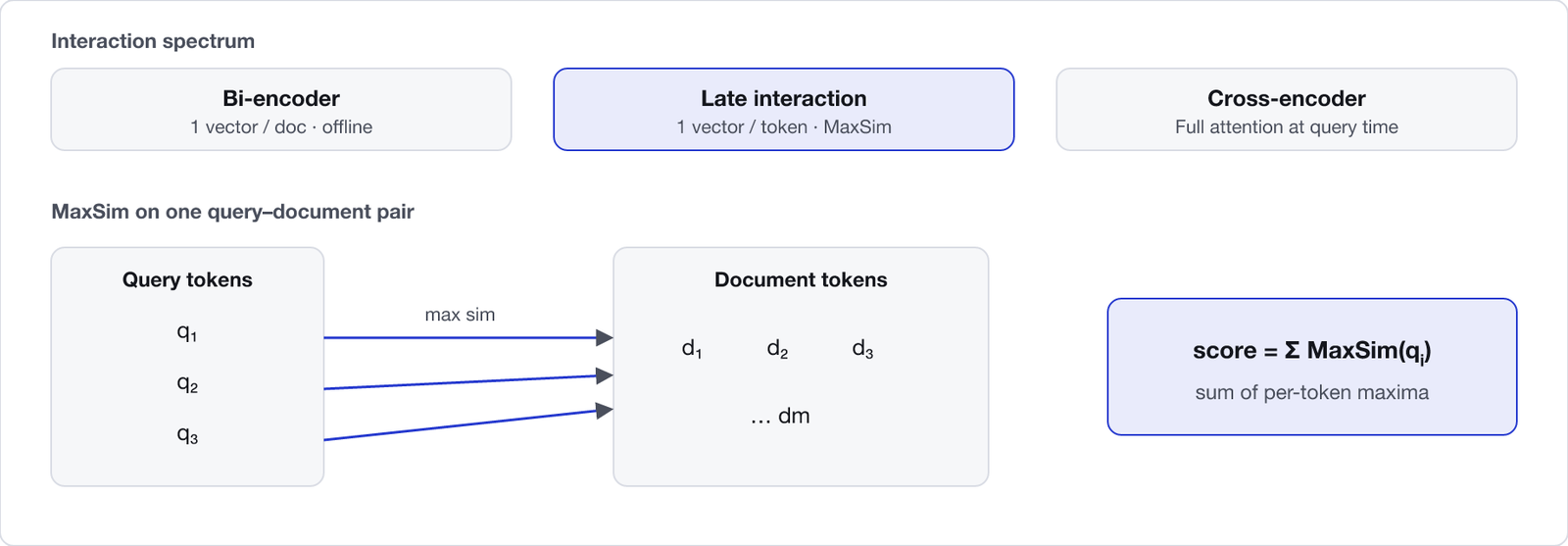
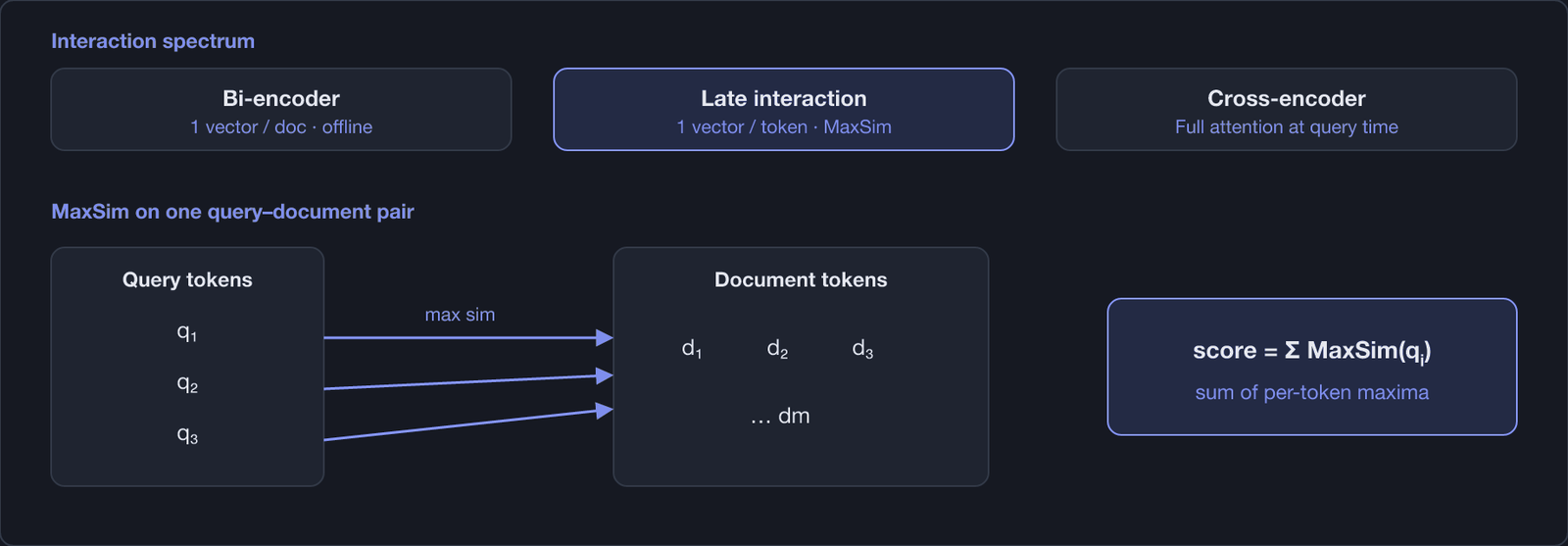
MaxSim is what makes ColBERT explainable relative to a single cosine: you can see which document tokens carried each query token’s maximum. That interpretability is a side effect of keeping token vectors, not a separate product feature.
How does late interaction differ from bi-encoders and cross-encoders?
Late interaction sits between bi-encoders and cross-encoders on purpose. Bi-encoders pool each document into one vector before comparison, which is fast at corpus scale and loses token-level nuance. Cross-encoders attend over the full query-document pair at query time, which is accurate on a shortlist and too slow for the whole collection. Late interaction keeps token vectors for both sides and delays the interaction until MaxSim, which Weaviate’s overview calls both scalable and contextually rich relative to single-vector search.
The practical consequence for RAG is placement on the spectrum. Use late interaction when you need more precision than dense retrieval and cannot afford a full cross-encoder over a wide shortlist, or when you want token-level explainability. Pure cross-encoding depth is cross-encoder reranking; the first-stage search that feeds either path remains on the retrieval hub.
What did ColBERTv2 change?
ColBERTv2 (Santhanam et al., NAACL 2022 / arXiv:2112.01488) keeps the same late-interaction architecture and changes two things that blocked production use of ColBERT v1: storage and supervision.
Weaviate’s overview attributes ColBERTv2’s quality gains to denoised supervision, including distillation from a MiniLM cross-encoder teacher and hard-negative mining, while residual compression cuts the MS MARCO index from about 154 GB on ColBERTv1 toward roughly 16 GB to 25 GB depending on bit width.
- Residual compression. Each token vector is stored as a high-precision centroid plus a low-precision residual. At 128 dimensions, ColBERTv2 uses 20 bytes/vector (1-bit residual) or 36 bytes/vector (2-bit residual), versus ColBERT’s 256-byte 16-bit encodings , the paper’s stated 6-10× space cut on late-interaction indexes.
- Denoised supervision. Training distills from a MiniLM cross-encoder teacher and mines hard negatives so the student learns to separate near-misses, not only easy random negatives (Santhanam et al., 2022; Weaviate ColBERTv2 section).
On MS MARCO Passage Ranking, ColBERTv2 reported 39.7% MRR@10 on the official-style split in their table and 40.8% MRR@10 on their 5 000-query Local Eval set , the paper’s claim of the highest MRR@10 of any standalone retriever at publication time. On 22 of 28 out-of-domain tests spanning BEIR, LoTTE, and Open-QA suites, it led the next retriever by up to about 8% relative. Those figures are from the 2022 paper; verify on your corpus and date before treating them as current leaderboard truth.
What does ColBERT cost in storage?
ColBERT stores one vector per token, not one vector per document, so index size scales with token count. On the MS MARCO collection, vanilla ColBERT needed 154 GiB; ColBERTv2 cut that to 16 GiB (1-bit) or 25 GiB (2-bit), including about 4.5 GiB for the inverted list (Santhanam et al., 2022, §5.3).
Even with aggressive residual compression, a multi-vector index stays larger than a single 768-dimensional embedding per chunk , Weaviate’s late-interaction storage table makes that comparison explicit for document counts from 100 to 10 000 at 100 tokens each. The structural rule for planning is: bytes ≈ tokens × bytes-per-token-vector, paid at index time when every passage is encoded once.
Query latency is separate from storage. The ColBERTv2 paper’s Python implementation sweep sits roughly in the 50-250 ms per-query range, with strong quality often reachable around 100 ms depending on probe depth and candidate count. Broader reranker latency curves across model families live on what reranking costs in latency.
Estimate tokens × bytes before you commit
Published MS MARCO GiB figures are for that collection’s tokenisation and index layout. Your chunk size, overlap, and language will change the bill. Multiply expected tokens by 20-36 bytes (ColBERTv2 residual encodings) as a floor, then measure the real index on a sample shard.
Storage is the decision variable most teams underestimate. Token-level vectors buy MaxSim quality; without ColBERTv2-style compression they can dominate the index bill relative to a single-vector collection in Weaviate, Qdrant, or Pinecone.
When should you use ColBERT instead of a cross-encoder?
Use ColBERT when you need token-level matching at retrieval scale , either as a first-stage multi-vector search over a large corpus, or as a rescoring pass over a wide shortlist where a full cross-encoder on every candidate is too slow. On MS MARCO’s official top-1000 re-rank setup, ColBERT re-ranking delivered over 170× speedup (and far fewer FLOPs) relative to BERT pair models while staying competitive on quality (Khattab & Zaharia, 2020).
Prefer a cross-encoder when the candidate set is already small (tens of chunks) and maximum pairwise precision matters more than multi-vector RAM. Skip or defer ColBERT when:
- The corpus is tiny and a single dense index already hits your recall target , you pay token-scaled storage for little gain.
- The shortlist is already clean on labelled retrieval metrics , a second stage that does not move NDCG/MRR is pure latency.
- You cannot afford multi-vector memory even after ColBERTv2’s 6-10× compression , residual encoding helps; it does not make multi-vector as small as one pooled embedding.
ValueLabs’ framing is useful here: you cannot rerank your way out of a broken first stage. If dense retrieval never surfaces the gold passage, late interaction as a first-stage retriever is the lever; if the gold is in the shortlist but ranked wrong, either ColBERT or a cross-encoder can reorder , pick by candidate-set size and storage budget. Prove the choice with Recall@k, MRR, and NDCG on your own labelled queries.
How do you use ColBERT in a RAG pipeline?
ColBERT has two documented placements (Khattab & Zaharia, 2020, §3.5-3.6):
- End-to-end multi-vector retrieval , index every passage’s token vectors, retrieve candidates with token-level approximate nearest-neighbour search, then refine with exhaustive MaxSim on that candidate set.
- Second-stage rerank , run BM25, dense, or hybrid search for recall, then rescore the shortlist with ColBERT MaxSim before generation.
The usual production RAG pattern is retrieve wide → reorder with ColBERT or a cross-encoder → generate. Stanford’s ColBERT repository and AnswerDotAI’s RAGatouille package are the common open tooling for indexing and search; LlamaIndex and similar frameworks expose ColBERT-style rerankers for the second-stage path (pondhouse LlamaIndex walkthrough, live 2026-07-27). Vector stores that document late-interaction or multi-vector retrieval paths include Weaviate; treat other stores as destinations to verify in their current docs rather than as a ranked bake-off here.
The comparison states the mechanism and the cost , not a runnable install. For pinned, output-shown pipeline code see building the pipeline; for the two-stage decision gate see reranking in RAG; for first-stage retrieval design see retrieval.
IBM Developer’s ColBERT article and Qdrant’s late-interaction explainer (both in the organic set as of 17 September 2026) place the same model in RAG as a re-ranker or as a first-stage multi-vector retriever. Either placement still pays the multi-vector storage bill that Weaviate quantifies.
Choose ColBERT when token-level precision is worth the multi-vector index; otherwise keep a cross-encoder on a short shortlist.
Stanford’s ColBERT repository and the SIGIR 2020 paper remain the primary citations for the architecture; Weaviate’s overview is the clearest practitioner map of MaxSim, storage, and ColBERTv2 compression as of the 17 September 2026 capture.
Late interaction can serve as first-stage retrieval or as a reranker over a dense shortlist. Either way the multi-vector footprint is the cost that decides against it when RAM is tight.
Keep the as-of date next to any ColBERTv2 compression figure you cite, because index footprints move with corpus size and bit width.
Late interaction is a retrieval architecture, not a drop-in cross-encoder. Weaviate’s overview, the ColBERT papers, and Jina’s explainers agree on MaxSim, multi-vector storage, and ColBERTv2 compression. Choose it when token-level precision and explainability beat a single vector and when you can pay the storage bill; keep a cross-encoder shortlist when the candidate set is already small and latency is dominated by pairwise scoring.
- ColBERT and late interaction
- Reranking cost and latency
- Cross-encoder reranking
- LLM reranking
- Reranker comparison