Deploying a RAG System
Deployment shapes for RAG — API service, batch, serverless — and the operational trade-offs of each.
Deploying a RAG system means moving a working retrieve→generate prototype into a serving shape that survives real traffic — with the knowledge base, embeddings and models versioned and rolled together. The three shapes are an always-on API service, a batch job and a serverless function; each trades latency, cost and operational complexity differently. This page is the shapes, the trade-offs and the ship path.
What does deploying a RAG system mean?
Productionising RAG is migrating a prototype into an operational service that handles real query diversity, stays within a latency budget and keeps the knowledge base fresh — not wrapping a notebook in an HTTP handler. Coralogix’s production-deployment guide (as of its live capture on 28 July 2026) names the challenges that show up only after you leave the demo: query diversity the test set never saw, retrieval accuracy under that diversity, latency management including tail latency, and content freshness as the corpus moves. A demo that answers three canned questions is not a deployment. The stage budget behind the latency challenge is at latency.
How is RAG deployment different from a normal API?
A normal API ships code. A RAG deployment ships code + a knowledge base + embeddings + retrieval and generation models that must stay versioned together — otherwise a “successful” release can still serve stale chunks or a mismatched embedding space. Coralogix’s deploy checklist makes the unit of ship explicit: version code, models and the knowledge base; run an embedding pipeline on corpus change; update the vector database without downtime; serve the models; run RAG-specific tests (retrieval relevance and answer quality, not only unit tests); monitor knowledge-base freshness; and roll out gradually with canary or blue-green deploys. Staging and production differ on knowledge-base size, real query volume, latency SLOs and whether a user-feedback loop exists. How to version the corpus, embeddings and prompts as one unit is at versioning.
What are the deployment shapes for RAG?
Three shapes cover almost every production RAG system. Pick by traffic pattern, not by fashion:
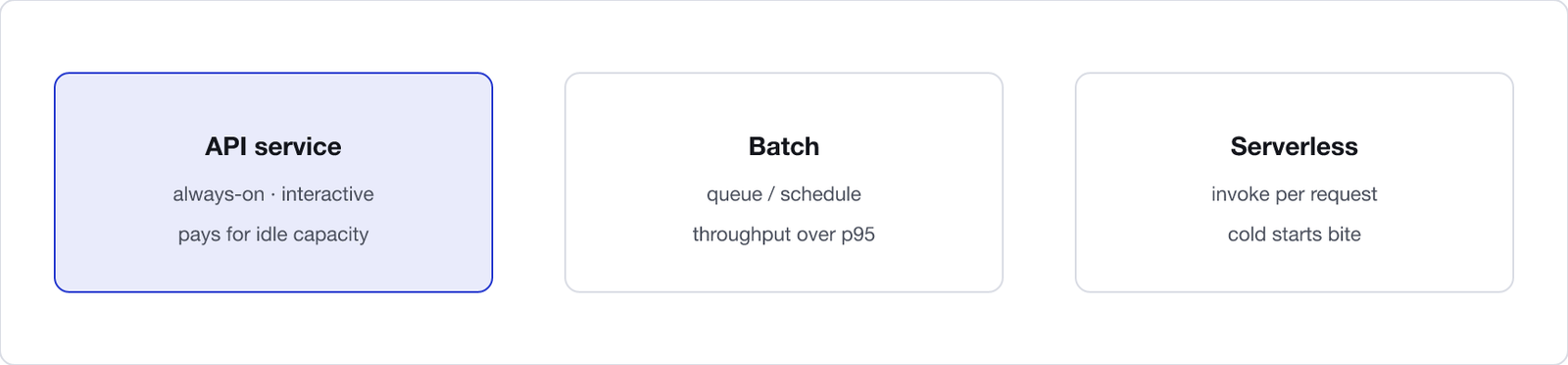
- Always-on API service — request/response retrieve→generate behind an HTTP or gRPC endpoint. Fits interactive chat and search. Coralogix’s API-layer guidance covers context-aware endpoints, streaming responses and feedback loops. You pay for capacity that sits warm between queries.
- Batch — run retrieval and generation over a queue or schedule (reports, nightly digests, triage). NVIDIA’s CVE-analysis example workflow is an event-driven batch RAG path: ingest a signal, retrieve context, generate a triage result — latency is throughput, not interactive p95.
- Serverless — invoke-per-request functions. Fits spiky or low traffic. Cold starts and in-memory index limits are the failure modes; the deep dive is at serverless RAG. Streaming token delivery, when the API shape needs it, is at streaming.
What are the trade-offs of each RAG deployment shape?
Pick the shape by traffic pattern and latency SLO. The trade-offs are structural, not vendor-specific:
- API service — lowest interactive latency when warm; highest always-on cost; needs autoscaling and rate limits so a traffic spike cannot blow the LLM bill.
- Batch — highest throughput per dollar; no interactive p95 to hold; needs a durable queue and idempotent jobs so a retry does not double-write.
- Serverless — pay-per-invocation; cold-start and index-load latency on the first call after idle; hard when the vector index must live in process memory instead of a managed store.
Most interactive RAG ships as an API service in front of a managed vector database. Batch and serverless are the right exceptions, not the default. Cost levers after the shape is chosen are at cost optimization.
How do you ship a RAG deployment pipeline?
Instrument the ship path once. Version code, models and the knowledge base together. Regenerate embeddings when the corpus changes. Update the vector index without downtime. Serve retrieve and generate behind the shape you chose. Gate the release on offline evaluation so a quality drop cannot merge — that gate is CI/CD for RAG. Roll out gradually (canary or blue-green) with a rollback path, as Coralogix and Dextralabs both prescribe in their production checklists (captured 28 July 2026). After it is live, three ops layers sit on top: monitoring for quality, latency and cost; observability to trace a bad answer to a stage; and caching so repeated work is not paid for twice. Where the stages themselves are assembled is build a pipeline.
What is RAG deployment?
Moving a working retrieve→generate prototype into a serving shape that survives real traffic, with the knowledge base, embeddings and models versioned and rolled together. A demo that answers three canned questions is not a deployment.
What are the deployment shapes for RAG?
Three: an always-on API service for interactive chat and search, a batch job over a queue or schedule for high-volume offline work, and a serverless function for spiky or low traffic. Most interactive RAG ships as an API service in front of a managed vector database.
How is RAG deployment different from deploying a normal API?
A normal API ships code. A RAG deployment ships code plus a knowledge base, embeddings and retrieval/generation models that must stay versioned together — otherwise a release can still serve stale chunks or a mismatched embedding space.
When should you use serverless RAG?
When traffic is spiky or low and you want to pay per invocation. Cold starts and in-process index loads are the failure modes, so it fits poorly when the vector index must live in memory inside the function. The deep dive is at /production/serverless.
What do you wire after a RAG deploy?
Three ops layers: monitoring for quality, latency and cost on live traffic; observability to trace a bad answer to a stage; and caching so repeated embeddings and answers are not paid for twice. Gate every release on offline eval in CI so a quality drop cannot merge.