Advanced RAG: What the Term Actually Covers
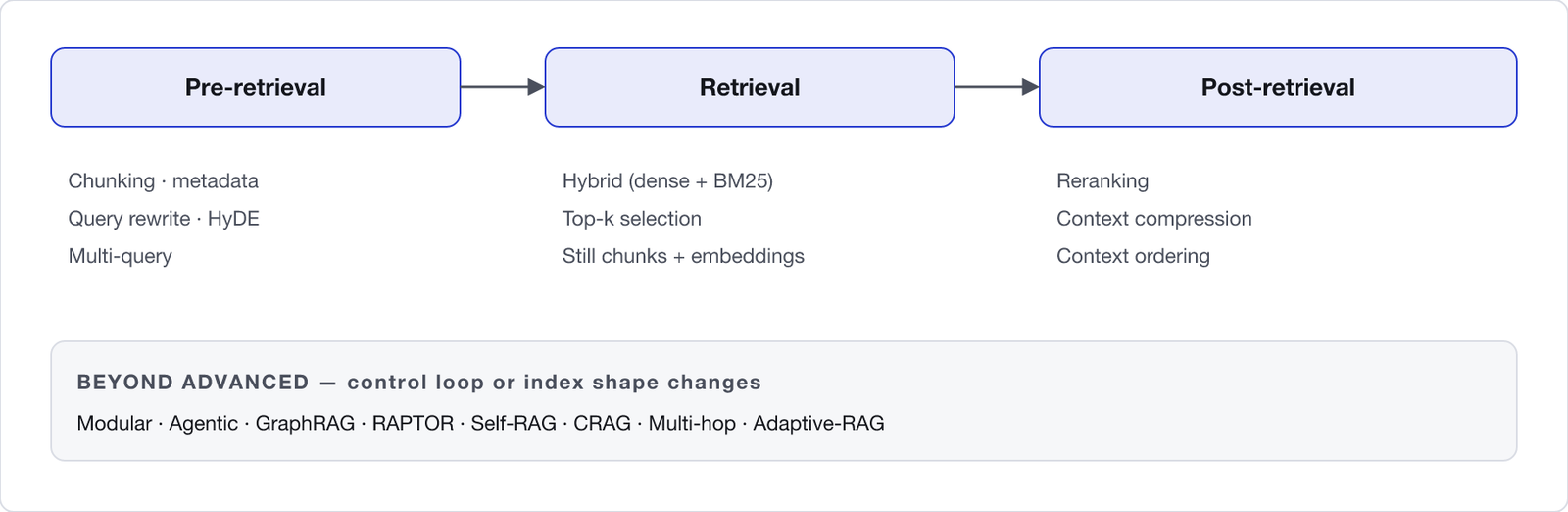
Pre-retrieval, retrieval and post-retrieval optimisations grouped by the failure each addresses.
Advanced RAG is Naive RAG plus quality-control layers at pre-retrieval, retrieval, and post-retrieval, while the system still retrieves chunks and then generates from them. Meilisearch’s December 2025 comparison of naive and advanced RAG defines advanced RAG as the same retrieve-then-generate shape with rewrite, multi-stage retrieval, reranking, and context pruning bolted on so precision rises when a single dense top-k pass is not enough. Gao, Xiong, Gao, and Liu’s survey (arXiv:2312.10997, 2023; revised 2024) named that middle rung on the Naive / Advanced / Modular ladder: Advanced upgrades the stages; Modular changes how stages are wired. This hub states what the term covers among the named patterns, groups techniques by the failure each stage fixes, and routes mechanism depth to the leaves that own it.
What is Advanced RAG?
Advanced RAG is Naive RAG with deliberate quality-control layers before candidates are scored, while they are scored, and after the shortlist returns, without replacing chunk-and-embedding retrieval as the default representation. Meilisearch (December 2025) states that advanced RAG builds on the naive approach by adding layers such as query rewriting, multi-stage retrieval, post-retrieval reranking and filtering, and auto-merging or context pruning before generation. Leewayhertz’s Advanced RAG architecture guide places Advanced beside Naive, Modular, and Agentic as named types on one ladder, which is the right vocabulary even when product pages later flatten those types into one “techniques” list.
Gao et al. (arXiv:2312.10997, 2023; revised 2024) are the survey that fixed the public names Naive, Advanced, and Modular for that ladder. Advanced in that framing still assumes a largely linear retrieve-then-generate skeleton: documents are chunked, embedded, indexed, retrieved, optionally refined, and then passed to a generator. PremAI’s comparison of simple, hybrid, agentic, and graph methods (2025) treats “simple RAG” as the baseline retrieve-once path and places hybrid retrieval as an accuracy upgrade inside that path, which matches how practitioners use “advanced” in production talk when they mean better stages rather than a new control loop.
The border that keeps the term useful is representation and control. Advanced RAG still retrieves passages (or passage-like units) from an embedding index, often fused with lexical search in stores such as Weaviate, Pinecone, Qdrant, or Milvus. Weaviate’s hybrid search documentation (as of September 2026) describes hybrid as combining dense vector results with BM25F keyword results on a single query string, with a server default of 0.75 for alpha when the request does not supply its own value. Modular RAG swaps and routes modules; agentic RAG lets an agent decide whether and how often to retrieve; GraphRAG changes the index shape to entities and relations. Those patterns are siblings on the architectures map, not synonyms of Advanced.
Leewayhertz’s components discussion for advanced systems also lists indexing, query transformation, query routing, orchestration, and generation as separate concern areas. That component list is useful as a checklist of stages a team might harden, and it is easy to misread as a requirement to adopt every item on day one. Advanced RAG earns the name when at least one pre-retrieval, retrieval, or post-retrieval control is intentional and measured. It does not require every blog technique to ship in the first release. Codelabs that walk chunking then reranking are teaching that staged discipline, not a mandate to run agent planners inside the same sprint.
That definition only matters if it explains why teams leave the naive baseline. The next question is what actually changes between a raw dense top-k pipe and an Advanced pipe that intervenes at every stage.
How does Advanced RAG differ from Naive RAG?
Advanced RAG differs from Naive RAG by intervening at every stage of the same retrieve-then-generate shape instead of accepting one dense top-k list as context. Meilisearch (December 2025) summarises the main difference as precision and control: naive RAG runs a single retriever loop, while advanced RAG adds layers so the context that reaches the model is filtered, ranked, and often rewritten for. Neo4j’s Advanced RAG techniques guide (2025) states why basic RAG breaks in practice: vector-only search misses exact tokens, there is no rerank step, filters are weak, and query understanding is thin.
DataCamp’s Advanced RAG article groups the same failure surface under limitations of basic systems: hallucination when retrieved context is weak, lack of domain specificity when the index and query never meet the user’s words, and difficulty with complex or multi-turn questions that need more than one retrieval pass worth of evidence. Meilisearch’s naive workflow is indexing (chunk, embed, store), retrieval (embed the query, similarity search), and generation (prompt with hits). Its advanced workflow inserts pre-retrieval optimisation, multi-stage retrieval, post-retrieval reranking and filtering, and auto-merging or context pruning before the final generate step.
The baseline walkthrough of that fixed pipe lives on Naive RAG. The usual first retrieval upgrade off dense-only search is hybrid search, and the usual precision pass after a broad candidate list is reranking. Which lever to try first when answers are wrong is ranked on pipeline accuracy, not by stacking every technique named in a Medium list. Advanced RAG is the name for that staged upgrade path while the control loop remains fixed.
Meilisearch’s limitation lists sharpen the same contrast from the operational side. Naive RAG’s weak precision and missing feedback loop are acceptable in a proof of concept and expensive in a customer-facing policy assistant. Advanced RAG’s higher complexity and harder evaluation are acceptable when a labelled regression set exists and unacceptable when nobody can say which stage moved. The difference is therefore not marketing language; it is whether the team will pay for stages it can observe.
Knowing the structural difference still leaves an operating question: when the extra stages are worth their latency and engineering cost, and when naive RAG remains the honest choice.
When should you use Advanced RAG?
Advanced RAG is the right upgrade when answer quality on a labelled set is the bottleneck and a single dense retrieve-then-generate pass has already been measured as insufficient. Meilisearch (December 2025) places advanced RAG in production settings that prioritise accuracy and hallucination control, including domain systems such as finance or healthcare assistants, customer-facing bots that must cite the right policy, and large corpora that need hybrid retrieval and multi-stage ranking. The same guide places naive RAG on prototypes, internal tools, small knowledge bases, and latency-first demos where a wrong answer is cheap.
Meilisearch’s benefit and limitation lists make the trade-off concrete without inventing a lift percentage for every corpus. Advanced RAG gains relevance through rewrite, multi-stage retrieval, and rerank, and it scales toward enterprise hybrid workloads; it also raises complexity, compute, API spend, and evaluation difficulty because more stages must be tuned and observed. Naive RAG stays simple, fast, and cheap to maintain, and it fails on precision, recall, freshness filtering, and feedback when those properties matter. PremAI’s method comparison table is useful as orientation across simple, hybrid, agentic, and graph shapes, not as a scored ranking for this site.
If answers are wrong and the failing stage is unknown, start at why RAG systems fail before shopping architectures. If the failing stage is already clear and the question is which upgrade to try first, open accuracy intervention order. Advanced RAG is not the name for every later pattern on the ladder; it is the name for making the fixed pipe fail less often.
Meilisearch’s when-to-use guidance also notes that naive RAG fits local or offline cases where data volume is small and latency must stay low. Advanced RAG fits large datasets and hybrid retrieval systems where missing an exact identifier or a paraphrased policy clause has a measurable cost. PremAI’s simple-versus-hybrid cut is the same decision in fewer words: stay simple while one channel answers the labelled set; add hybrid and later stages when channel coverage or precision is the measured miss.
The practical content of that name is the technique set. Those techniques group cleanly by stage, starting with what happens before any candidate is scored.
What pre-retrieval upgrades belong in Advanced RAG?
Pre-retrieval upgrades in Advanced RAG prepare the index and the query so the first candidate list is less wrong before any second-pass model runs. Meilisearch’s advanced workflow opens with pre-retrieval optimisation: rewrite the user query so domain terms and intent match what the index actually stores. Neo4j’s guide groups the same work under making documents easier to retrieve and improving query understanding, including chunking choices, parent retrievers, hypothetical questions as a retrieval variant, and query expansion. Medium’s Data Science Collective Advanced RAG techniques survey (2025) spends its opening inventory on encoders, vector stores, query rewrite and transformation, query routing, query expansion, and chunking for the same reason: failures that start at ingest or query formulation cannot be fixed by a better reranker alone.
On this map, chunk optimisation is owned by the chunking cluster rather than restated here. Chunking strategies set the ceiling every later stage inherits. Semantic chunking splits on meaning when fixed windows destroy recall. Hierarchical and parent-document chunking retrieve small and return large when answers straddle boundaries. Late chunking and contextual retrieval keep document context attached when isolated slices lose meaning. Metadata extraction supplies the fields that make filtering, permissions, and freshness possible at query time. Those leaves carry sizes, overlap rules, and failure modes; this hub only places them under pre-retrieval.
Query-side pre-retrieval is the other half. Query rewriting and expansion exist because the user’s question is rarely the best search string. HyDE generates a hypothetical answer, embeds that answer, and searches answer-to-answer when sparse queries fail to meet dense passages. Multi-query retrieval and reciprocal rank fusion ask several variants and merge ranked lists when one phrasing under-covers the corpus. Google Cloud’s Advanced RAG Methods codelab treats chunking comparison as the first lab module before reranking, which matches the promotion order: fix what enters the index, then fix how the query is formed, then spend on second-stage models.
Neo4j’s “hypothetical questions as a retrieval variant” is the same family as HyDE: generate text that looks like an answer or like indexed questions, then retrieve against that richer string instead of against a short user utterance. Medium’s query routing and expansion inventory adds the reminder that routing to the wrong collection is a pre-retrieval failure even when embeddings are strong. Metadata filters from fields that enable faceted filters belong in that same early gate when permissions or product lines must constrain the candidate pool before similarity scores run.
Once the index and query are prepared, the next failure surface is how candidates are scored and fused into one shortlist.
What retrieval upgrades belong in Advanced RAG?
Retrieval upgrades in Advanced RAG change how indexed chunks are scored against the prepared query, usually by combining channels instead of trusting dense neighbours alone. Neo4j (2025) lists hybrid retrieval (semantic plus lexical), filtering, and then reranking as the core path to better candidate quality. DataCamp’s Advanced RAG article pairs dense retrieval with hybrid search as the first advanced retrieval techniques, and Medium’s survey treats fusion retrieval and hybrid search as first-class retrieval optimisations. Meilisearch’s multi-stage retrieval step pulls from more than one source type so coverage rises before any generator prompt is built.
The usual first upgrade off Naive dense-only search is hybrid retrieval, which runs lexical and vector channels and fuses the lists. Weaviate’s hybrid search documentation (as of September 2026) gives 0.75 as the server default for alpha when a request arrives with no value, weighting vector results above keyword results, and notes that some client libraries send their own alpha, so pipelines that care about the mix should set it explicitly. Lexical scoring detail for the keyword leg lives under BM25. The wider decision surface for metrics, top-k, and self-query filters lives on the retrieval hub.
Fusion variants that expand the query set and merge ranks sit next to hybrid rather than inside it. Pinecone’s Advanced RAG Techniques guide (March 2024) centres Self-RAG, Corrective RAG, and RAG Fusion as named methods teams combine; on this site RAG Fusion’s reciprocal-rank mechanics belong with multi-query fusion depth rather than as a synonym of Advanced itself. Open RAG Fusion when the failure is under-coverage from a single query string and the fix is multiple generated queries plus fusion. Retrieval upgrades raise recall and channel coverage; they do not by themselves decide which of fifty hits the model should read first.
Filtering belongs with retrieval upgrades when the corpus is permissioned or faceted. Neo4j lists filtering beside hybrid retrieval because a high similarity score on the wrong tenant’s documents is still a miss. Self-query and metadata filters deepen that path on the retrieval leaves; the Advanced hub only requires that filters are treated as part of scoring hygiene rather than as an afterthought bolted on after generation already failed.
That ordering and thinning problem is post-retrieval, where Advanced RAG earns much of its production reputation.
What post-retrieval upgrades belong in Advanced RAG?
Post-retrieval upgrades in Advanced RAG refine an already retrieved shortlist so the generator sees fewer noisy tokens and a better order. Meilisearch (December 2025) names post-retrieval reranking and filtering as the eliminator for less relevant hits, and auto-merging or context pruning as the step that removes overlap and low-value text before generation. Neo4j groups reranking with text summarisation or context distillation and with parent retrieval patterns that return wider context after a precise hit. DataCamp lists reranking and context distillation under relevance optimisation, and Google Cloud’s Advanced RAG Methods codelab makes reranking its second lab module after chunking.
Second-pass scoring is owned by the reranking cluster. Second-stage reranking reorders the shortlist with a more expensive model after a cheap first-stage retriever has narrowed the corpus. cross-encoders score query and document together and are the usual precision instrument when latency budgets allow a short candidate list. Medium’s survey places cross-encoders beside bi-encoders for that reason: bi-encoders retrieve at scale; cross-encoders judge a handful of survivors. Latency, model choice, and when a strong reranker makes weak fusion redundant stay on those leaves.
Context assembly after the shortlist is ordered is owned by the context cluster. contextual compression shrinks retrieved text before generation so recall survives while token waste falls. Context ordering places the best evidence where the model will actually use it, including lost-in-the-middle mitigations when long prompts bury mid-list chunks. Post-retrieval does not repair a missing document or a query that never matched the index; it improves what the fixed pipe already found.
DataCamp’s context distillation and Neo4j’s summarisation notes describe the same pressure: long candidate lists blow the context window and dilute attention. Compression and ordering are therefore Advanced moves even when the retriever is already hybrid. Teams that skip them often misdiagnose the failure as “the model cannot reason” when the prompt simply buried the right chunk under redundant neighbours.
Many lists labelled “advanced RAG techniques” then jump to agents, graphs, and trained critics. Those patterns matter, but they are not Advanced RAG in the Gao sense, and they need their own leaves.
Which architecture patterns sit beyond Advanced RAG?
Architecture patterns beyond Advanced RAG change the control loop or the index shape instead of only upgrading stages on a fixed retrieve-then-generate pipe. Pinecone’s Advanced RAG Techniques guide (March 2024) leads with Self Reflective RAG, Corrective RAG, and RAG Fusion. PremAI compares simple, hybrid, agentic, and graph methods in one article. Neo4j’s technique list includes GraphRAG, corrective RAG, multi-hop QA, and agentic planning. Leewayhertz places Modular and Agentic as types beside Advanced. Those pages are useful inventories; they are also how “advanced” becomes a landfill that hides the taxonomy.
Modular RAG treats stages as swappable modules under routing and fusion topologies, which Gao et al. place as the next paradigm after Advanced. Agentic RAG lets an agent decide whether, what, and how often to retrieve inside a reasoning loop. GraphRAG retrieves over entities and relations rather than flat passage chunks alone. RAPTOR builds a recursive cluster-and-summarise tree for long-document questions. Self-RAG uses reflection tokens and on-demand retrieval as a trained critique loop. Corrective RAG (CRAG) grades retrieval quality and falls back when the corpus is insufficient. Multi-hop RAG iterates retrieval across documents for composition questions. Adaptive RAG routes no-retrieval, single-step, or multi-step paths by query complexity.
Keeping that beyond-Advanced band explicit is what separates this scope map from flat technique dumps. A team that needs hybrid search and a cross-encoder is still on Advanced. A team that needs an agent to call two tools and rewrite mid-flight has left Advanced for an agentic control plane. Naming the border stops architecture shopping from looking like a longer checklist.
Pinecone’s “combining the methods” framing is still compatible with that border: query generation, evaluation, critique, and reranking can sit on a fixed pipe, while Self-RAG and CRAG add trained or graded control that this site files under critique architectures. PremAI’s agentic and graph rows are likewise real patterns; they answer different failures than Advanced’s stage upgrades, which is why they receive their own URLs rather than another bullet under post-retrieval.
When the diagnosis is still “naive is not enough” and the cure is still stage upgrades, the remaining operational question is how to promote the pipe without boiling the ocean.
How should you move from Naive RAG to Advanced RAG?
You should move from Naive RAG to Advanced RAG by measuring a labelled failure, adding one stage-level upgrade at a time, and re-measuring before stacking the next lever. Meilisearch’s best-practices section for the naive-to-advanced journey (December 2025) emphasises evolving the pipeline rather than rewriting it wholesale: start where precision or recall is failing, then add rewrite, hybrid retrieval, or rerank as the evidence demands. Neo4j’s practical plan using advanced RAG techniques follows the same order: structure sources, improve retrieval quality, add query understanding, and only then reach for agentic planning on complex multi-step questions.
That promotion path matches the accuracy hub’s intervention order: fix what the index can find and how the query is scored before spending on generator fine-tuning or multi-agent orchestration. End-to-end wiring of ingest, retrieve, and generate belongs on how to build a RAG pipeline from scratch. Ranked which-upgrade-first guidance belongs on which upgrade to try first. Stage isolation when the wrong answer has no named owner belongs under RAG failure modes. Google Cloud’s Advanced RAG Methods codelab is a useful lab sequence for chunking then reranking; it is not a substitute for a regression set on your own corpus.
Weaviate remains the default worked example when a vector store is named beside Pinecone, Qdrant, or Milvus for hybrid retrieval during that migration. Placement does not invent a benchmark: hybrid search, explicit alpha, and a shortlist rerank are the portable Advanced moves, and each product documents its own fusion knobs. Skip Modular or Agentic control changes until a fixed Advanced pipe has been given a fair test on the labelled misses that motivated the upgrade.
Meilisearch’s move-from-naive guidance also warns that advanced layers raise maintenance cost. That cost is why the migration is staged: ship hybrid, measure, ship rewrite or HyDE, measure, ship a cross-encoder on a capped candidate list, measure. Neo4j’s plan that reserves agentic planning for complex multi-step questions is the same discipline from the other direction: do not pay agent-loop latency for FAQ lookups that Advanced stages already answer.
Promotion without measurement is how Advanced RAG becomes an expensive synonym for “we added libraries.” The last hub question is what to measure so the upgrade is real.
How do you measure whether Advanced RAG helped?
You measure whether Advanced RAG helped by holding a labelled question set fixed, scoring retrieval and generation separately, and changing one stage at a time so a hybrid or rerank lift is attributable. Meilisearch’s evaluate section for naive versus advanced RAG (December 2025) frames the comparison around accuracy, relevance, and the operational cost of the extra layers. Neo4j’s evaluate-your-tactics guidance and DataCamp’s quality sections make the same demand: advanced techniques are hypotheses until retrieval metrics and answer metrics move on your corpus.
Depth for metric definitions, judges, and frameworks lives elsewhere on purpose. Open how to evaluate a RAG system for the evaluation hub, retrieval metrics for recall and ranking measures, and ranked accuracy interventions for intervention order once a weak stage is known. DeepLearning.AI’s Building and Evaluating Advanced RAG course is a ranking-page signal that evaluation is part of the Advanced topic; course exercises are not copied here. This hub only states the measurement rule that keeps Advanced RAG honest: if hybrid search and a cross-encoder do not move the labelled metrics, the next technique on a Medium list is not the diagnosis.
A minimal Advanced measurement pack is a frozen question set, a retrieval slice that records whether the gold passage appeared in the top-k before and after each stage change, and a generation slice that records faithfulness or answer correctness on the same questions. Change only chunking, or only hybrid fusion, or only the reranker between runs. Meilisearch’s cost warning applies here too: if the extra stages do not move those scores, the engineering cost of Advanced RAG is not justified on that corpus yet.
Advanced RAG is the second-generation name for a fixed retrieve-then-generate pipe that fails less often because pre-retrieval, retrieval, and post-retrieval stages each get explicit quality control. Meilisearch, Neo4j, DataCamp, PremAI, Pinecone, and Leewayhertz all describe pieces of that upgrade path; Gao et al. still supply the taxonomy that keeps Advanced from swallowing Modular, Agentic, and Graph patterns. Use Advanced when labelled misses show weak stages on a single-shot pipe, route each technique to the leaf that owns its mechanism, and keep architecture siblings for the day the control loop or the index shape itself must change.